

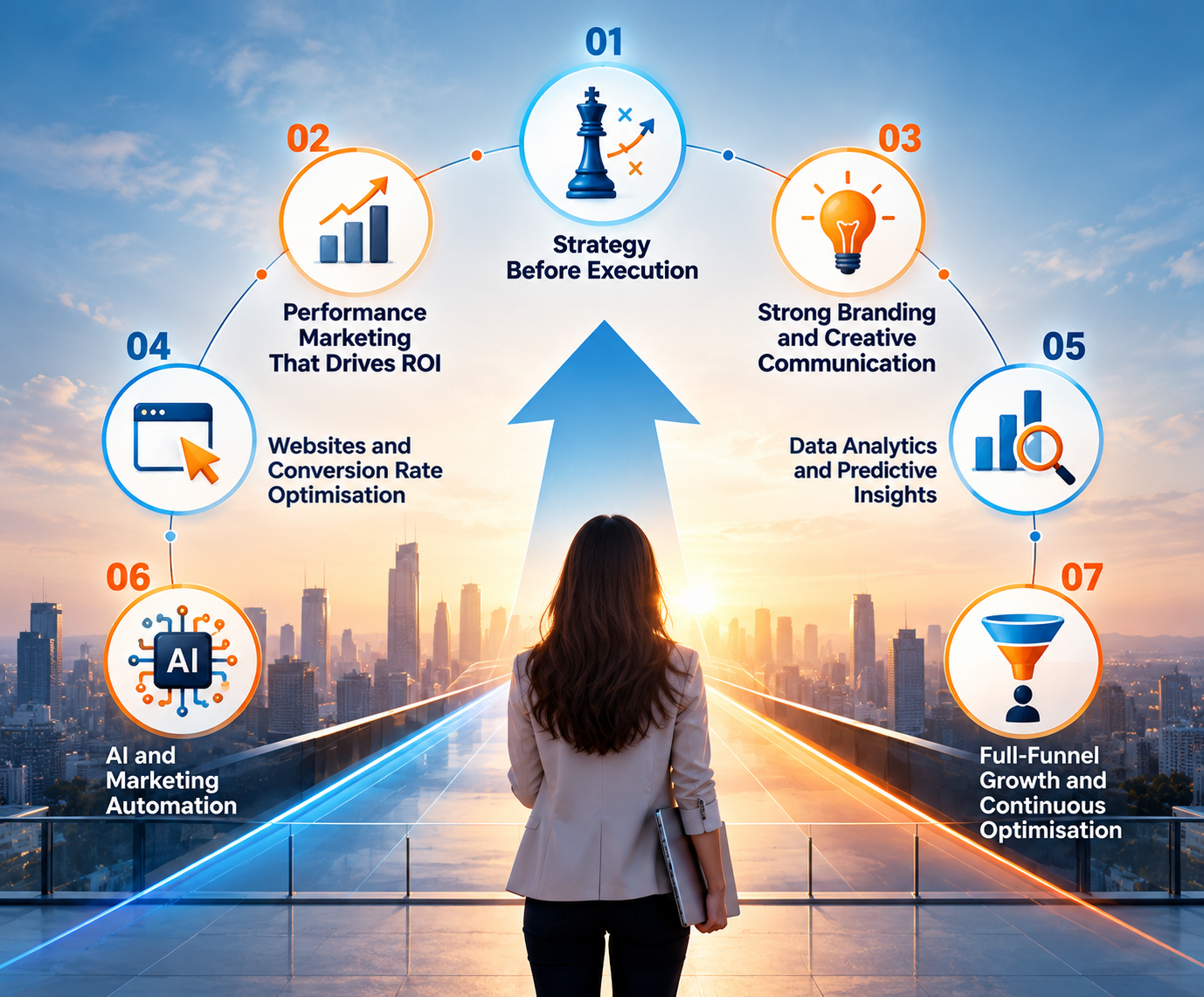
Business growth is not just about spending more on marketing. It is about making better decisions, reaching the right audience, and turning opportunities into measurable results.
In today’s competitive digital landscape, businesses need more than advertisements, social media posts or a well-designed website. They need a connected growth strategy that brings together marketing, technology, creativity, data and insights.
1. Strategy Before Execution
Every successful marketing campaign starts with a clear strategy. Before investing in advertising or content creation, businesses must understand their target audience, market position, competitors and commercial objectives.
A well-defined strategy identifies the right channels, budgets, customer segments and performance indicators.
Whether the objective is generating leads, increasing e-commerce sales or building brand awareness, the strategy should align marketing activities with business priorities.
Growth principle: Start with the business objective, not the marketing channel.
2. Performance Marketing That Drives ROI
Performance marketing helps businesses reach potential customers through platforms such as Google Ads, Meta Ads and LinkedIn Ads.
However, running campaigns is only the beginning. Sustainable performance requires continuous testing, audience refinement, creative optimisation and budget allocation.
Businesses should measure meaningful indicators such as customer acquisition cost (CAC), return on ad spend (ROAS), conversion rates and lead quality.
The goal is not simply to generate more traffic. It is to acquire the right customers at an economically viable cost.
Growth principle: Optimise campaigns for business outcomes, not vanity metrics.
3. Strong Branding and Creative Communication
Even the most sophisticated advertising campaign can struggle when its message fails to connect with the right audience.
Brand positioning, visual identity, content and advertising creatives influence how customers perceive a business and whether they trust its offering.
Businesses should communicate their value clearly and consistently across websites, social media, advertisements and other customer touchpoints.
Creative testing is equally important. Different headlines, formats and messages can reveal what resonates with specific audience segments. A compelling, well-structured brand story that resonates with customers, addresses their pain points, and aligns with their needs can significantly improve engagement, build trust, and drive business growth.
Growth principle: Make your brand recognisable, relevant and worth remembering.
4. Websites and Conversion Rate Optimisation
Driving visitors to a website is valuable only when the experience encourages them to take the next step.
A slow website, confusing navigation, unclear messaging or complicated enquiry form can waste marketing investment.
A conversion-focused website combines clear communication, mobile responsiveness, fast loading, intuitive navigation and strong calls to action.
Conversion rate optimisation (CRO) takes this further by using analytics, user behaviour and structured experiments to identify opportunities for improvement.
Growth principle: Before increasing traffic, make sure your website design is ready to convert it.
5. Data Analytics and Predictive Insights
Marketing decisions become more effective when they are supported by reliable data.
Tools such as Google Analytics 4, Google Tag Manager, CRM systems and advertising-platform reporting help businesses understand customer behaviour and campaign performance.
Beyond reporting past results, businesses can use historical data, forecasting and predictive models to estimate demand, identify promising customer segments and plan budgets more effectively.
Accurate conversion tracking is essential. Without it, businesses risk making decisions based on incomplete information.
Growth principle: Measure what matters, understand why it happens and use those insights to improve the next decision.
6. AI and Marketing Automation
Artificial intelligence is changing how businesses plan, execute and analyse marketing activities.
AI-enabled marketing solutions can support content ideation, creative variations, audience research, campaign analysis, reporting and predictive modelling. Automation can connect marketing platforms with CRM systems, email workflows and lead-management processes.
For example, a business can automate lead assignment, follow-up notifications and reporting, allowing its team to respond faster and spend less time on repetitive work.
However, technology alone does not guarantee results. Human judgement, reliable data and clear business objectives remain essential.
Growth principle: Use AI to improve speed, insight and efficiency while keeping strategy and accountability in human hands.
7. Full-Funnel Growth and Continuous Optimisation
Business growth rarely happens through a single campaign or channel. Customers move through different stages before making a purchase and may need ongoing engagement afterward.
A full-funnel approach connects brand awareness, customer consideration, acquisition, conversion and retention.
It also brings paid advertising, SEO, social media, content, websites and customer relationship management into a coordinated strategy.
Regular performance reviews help businesses identify bottlenecks, reallocate budgets and discover new growth opportunities.
Growth principle: Treat marketing as a continuous growth system, not a collection of disconnected activities.
Bringing the Seven Elements Together
The strongest growth strategies combine all seven elements into one coordinated approach.
Strategy defines the direction. Performance marketing attracts potential customers. Branding builds recognition. Websites convert interest into action. Analytics provides clarity. AI and automation improve efficiency. Full-funnel optimisation connects everything.
Because sustainable growth is not about doing more marketing. It is about making marketing work harder for your business.